
Foreclosure Properties For Sale In Seattle, WA
Seattle’s housing market is competitive. Prices are high. Inventory is tight. So it makes sense that thousands of buyers and investors search for foreclosure properties in Seattle every month, hoping to find a deal that the regular MLS can’t offer.
But Seattle foreclosures work differently than most people expect. There are fewer true bargains than the headlines suggest, the buying process has real complications, and the right strategy depends entirely on what type of foreclosure you’re looking at and what your goals are.
This guide will walk you through every stage: what types of foreclosures exist in the Seattle area, how Washington State’s foreclosure process actually works, where to find legitimate listings, how to finance a distressed purchase, and what to watch out for before you make an offer.
I’ve been a real estate investor in the Greater Seattle area since 2002, and a licensed real estate broker since 2008. I’ve bought distressed properties, worked with investors on flips and BRRRR strategies, and helped buyers navigate bank-owned purchases from offer through closing. Here’s what I know.
How Foreclosure Works in Washington State
Washington is a deed of trust state, which means most home purchases are secured by a deed of trust rather than a traditional mortgage. This matters because it determines how the foreclosure process works — and it’s different from what you may have heard about other states.
Washington primarily uses non-judicial foreclosure (also called a trustee’s sale). Here’s the basic timeline:
- Default: The homeowner falls behind on payments, typically by 30–90 days.
- Notice of Default: The lender records a Notice of Default and sends it to the borrower. The homeowner has 30 days to cure the default before the process continues.
- Notice of Trustee’s Sale: If the default isn’t cured, the lender records a Notice of Trustee’s Sale. Washington law requires a minimum of 90 days between this notice and the actual auction.
- Trustee’s Sale (Auction): The property is sold at a public auction, typically at the county courthouse. In King County, these sales take place at the King County Courthouse in downtown Seattle. In Snohomish County, auctions happen at the Snohomish County Courthouse in Everett, typically on Friday mornings.
- REO (Real Estate Owned): If no buyer purchases the property at auction, the bank takes title and the property becomes an REO — available for purchase through normal real estate channels.
Important Washington State note: Unlike judicial foreclosure states, Washington’s non-judicial process does not include a post-sale redemption period. Once the trustee’s sale is complete, the former owner has no right to reclaim the property. This makes Washington foreclosure auctions legally cleaner for buyers — but the speed of the process also means opportunities can move fast.
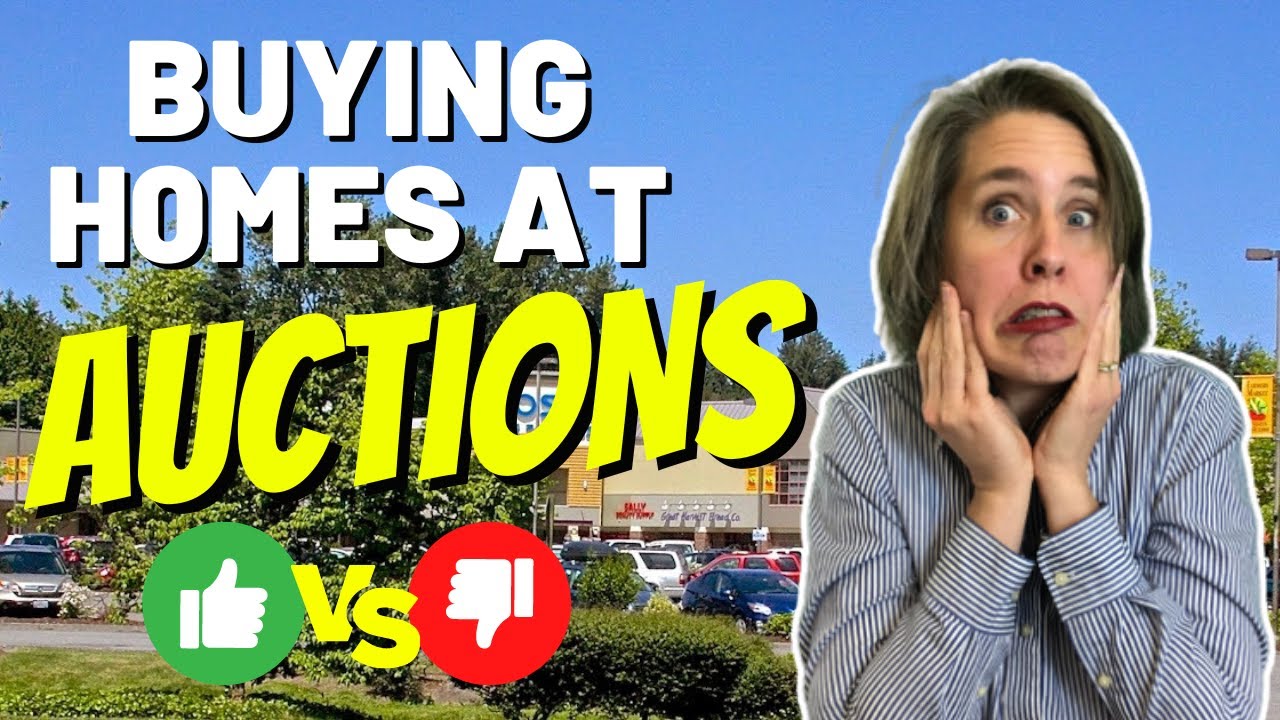
Why I Do Not Like To Buy Properties At The Courthouse Steps
Types of Foreclosure Properties Available in Seattle
Not all foreclosures are the same. Each type has a different buying process, different risk level, and different potential for a deal. Here’s a breakdown:
Pre-Foreclosure Properties
A property is in pre-foreclosure when the homeowner has defaulted on their mortgage but the bank has not yet completed the foreclosure process. The owner still holds title. These can be excellent opportunities because there’s less competition than at auction or on the open market — but they require finding the homeowner, negotiating directly, and often helping them understand their options.
Options for homeowners in pre-foreclosure include: bringing the loan current, arranging a short sale (selling for less than is owed with bank approval), or selling to an investor for a fast cash close before the bank forecloses. If you’re a homeowner in pre-foreclosure and exploring your options, the sell your house page walks through your choices, and I’m happy to talk through what makes sense for your situation.
Courthouse Steps Auction (Trustee’s Sale)
These are the auctions that happen at the King County and Snohomish County courthouses. They require:
- Cash only — you must bring a cashier’s check for the full purchase amount the same day
- No interior inspection — you’re bidding on a property you cannot tour ahead of time
- Title risk — junior liens may survive the sale depending on the circumstances
- Speed — you must be ready to close immediately
Courthouse auctions are almost exclusively for experienced investors with significant capital. They’re not a path for first-time buyers or those relying on financing.
REO Properties (Bank-Owned Homes)
If a property doesn’t sell at auction, the bank takes ownership and it becomes REO. These are the foreclosures most buyers actually end up purchasing, because:
- They’re listed on the MLS through a traditional agent (or directly through the bank’s asset management portal)
- You can schedule a showing and inspection
- You can use financing in most cases (with the right loan type)
- The title is cleaner than a courthouse auction purchase
The trade-off: REO homes are usually sold as-is, utilities may be off, and the condition ranges from cosmetic fixer to structural disaster. Banks are not required to disclose defects they don’t know about — and they often genuinely don’t know what’s wrong with the property.
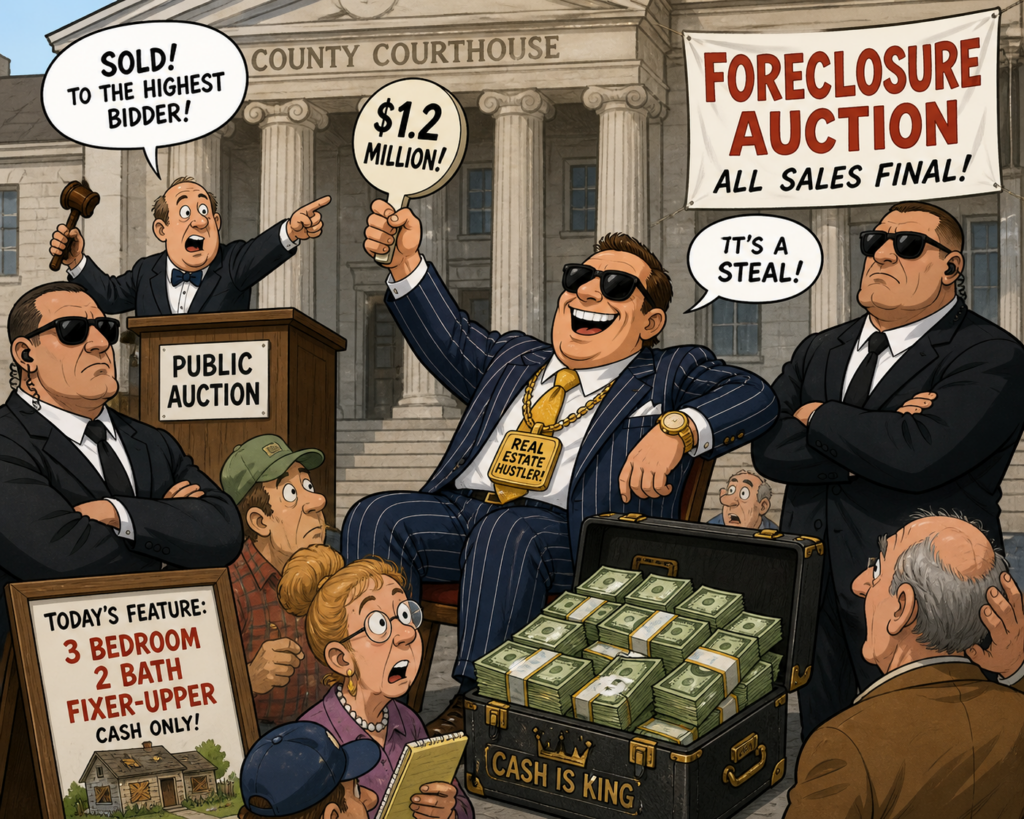
Foreclosure Auctions At The Courthouse Steps
Once the bank has foreclosed the home – it will try to sell it at auction on the courthouse steps. This is a very difficult way for most investors to buy property, because they must come to the courthouse with enough cash to buy the property the same day (they can’t apply for a mortgage from a traditional lender), and they can’t enter the property ahead of time to tour and inspect it and see what it looks like inside. So, it’s kind of a gamble for investors to try to buy houses at foreclosure auctions.
If you want to try it, you can visit the Snohomish County courthouse in Everett and see the property auctions live on Friday mornings.
The Foreclosure Property May Become An REO (“Real Estate Owned” By The Bank)
If no investor is able or willing to buy the house at foreclosure auction at the courthouse steps, then the bank will take the property back. Now, the property is owned by the bank and it will need to work with a listing agent in order to sell it to somebody else.
Foreclosure Properties Are Vacant And Can Be Ugly And In Need Of Repair!
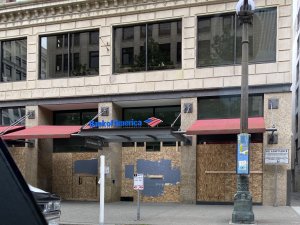
Usually bank owned properties have all the electricity shut off, sometimes with windows boarded up to prevent damage from squatters or vandals, and usually the water pipes have been “winterized” so they don’t freeze, and you can’t run the water or use the toilet in the home. If you are going out to look at bank owned properties, it’s a good idea to bring a flash light and be prepared for the unexpected.
Many REO homes are in need of extensive repair. Some may have structural damage in the foundation or roof. Others could have mold or moisture issues. Almost all need at least paint and new carpet, and often times new kitchen and bathroom cabinets. Whoever buys the home from the bank may need to invest several months and tens of thousands of dollars in rehab costs in getting the home fixed up for resale on the MLS. In order to account for this time, money and risk the investor expects to make a reasonable profit.
Many rehab investors, or “house flippers” as they are sometimes called, are working full time in the real estate industry and need to make enough money to support themselves and their families with their projects. If you are entering the marketing and starting to look at buying foreclosure properties for sale in Seattle, WA, it’s a good idea to get a sense of how you will be funding the project before you start making offers.
HUD Homes
When a borrower defaults on an FHA-insured loan, HUD takes ownership of the property after foreclosure. These properties are sold through HUD’s asset management contractors and listed on HUDHomeStore.gov. Owner-occupants (buyers who intend to live in the home) get a first-look period before investors can bid — which can be a real advantage for primary residence buyers looking for a deal.
Fannie Mae HomePath and Freddie Mac HomeSteps
Government-sponsored enterprises Fannie Mae and Freddie Mac sell their foreclosed properties through their own platforms. Fannie Mae’s program is called HomePath; Freddie Mac’s is HomeSteps. These programs often offer favorable financing terms, reduced earnest money requirements, and first-look periods for owner-occupants.
Short Sales
A short sale happens when the homeowner sells the property for less than the outstanding loan balance, with the bank’s approval. Short sales are not technically foreclosures — the owner still controls the sale — but they’re often grouped with distressed properties because they involve a homeowner in financial difficulty. The process can be slow (bank approval takes time), but the property condition is typically better than a true REO, and there’s more opportunity for negotiation.
Where to Find Foreclosure Properties in the Seattle Area
Here’s where to actually look, depending on what type of property you’re targeting:
- NWMLS / MLS listings: REO properties and short sales are listed on the MLS just like regular homes. Search with your agent filtering for bank-owned or short sale status. Browse all available properties through our search portal — set up alerts and we’ll notify you when distressed properties that match your criteria hit the market.
- HUD Home Store: hudhomestore.gov for FHA foreclosures
- Fannie Mae HomePath: fanniemae.com/homepath
- Freddie Mac HomeSteps: freddiemac.com/homebuyers/homeSteps
- King County Courthouse: Trustee’s sales at the King County Courthouse, 516 3rd Ave, Seattle. Check published notices in local newspapers or through the county recorder.
- Snohomish County Courthouse: 3000 Rockefeller Ave, Everett — auctions typically on Friday mornings.
- Auction.com: Auction.com lists online and in-person foreclosure auctions.
- Direct mail to pre-foreclosure owners: A common investor strategy — targeting owners who have received a Notice of Default before the auction happens.
How to Finance a Foreclosure Purchase in Seattle
This is where a lot of buyers get tripped up. Standard conventional and FHA loans have property condition requirements — if the home doesn’t have working utilities, has health/safety hazards, or is missing major systems, the loan won’t go through. Many foreclosures fail these requirements.
Here are the financing options that actually work for distressed properties:
Cash
The most flexible option, and the only option for courthouse auctions. Cash buyers can move fast, waive financing contingencies, and negotiate from strength. The trade-off is tying up significant capital.
FHA 203(k) Renovation Loan
This FHA program allows you to finance both the purchase price AND the cost of repairs in a single loan. It’s specifically designed for fixer-uppers and works well on REO properties that need work. There are two versions: the standard 203(k) for major renovations, and the limited 203(k) for smaller projects under $35,000.
Fannie Mae HomeStyle Renovation Loan
Similar to the 203(k) but available through conventional (non-FHA) financing. Allows up to 75% of the appraised after-renovation value. Works on investment properties as well as primary residences.
Hard Money / Private Money Lending
Short-term, asset-based loans often used by investors who plan to rehab and flip or refinance (BRRRR strategy). Higher interest rates and fees, but fast to close and few property condition restrictions. If you’re interested in the BRRRR or investment property strategy, I can connect you with lenders I’ve worked with in this market.
HomePath Mortgage (Fannie Mae Properties Only)
Available exclusively on HomePath properties, this program offers low down payments and no appraisal requirement, which speeds up the transaction considerably.
What to Expect When Buying a Seattle Foreclosure

The Deals Are Real — But So Are the Risks
Foreclosures can offer meaningful discounts, but the discount exists for a reason. Bank-owned homes are sold as-is, with no seller disclosures, no repairs, and often no utilities on during inspection. Whatever condition issues the previous owner ignored, plus whatever happened during the vacancy period — mold, freeze damage, vandalism, deferred maintenance — are yours to deal with after closing.
Before you make an offer, get a contractor you trust through the property. Understand the repair scope and costs before you fall in love with the purchase price.
Banks Are Slow and Bureaucratic
When you buy from a bank, you’re dealing with an asset manager, often in a different state, working off a spreadsheet. Responses can take days or weeks. Negotiations feel impersonal. Addendums are lengthy and bank-favorable. This is normal — not a red flag — but you need patience and a good agent who has done this before.
Competition Can Still Be Significant
Well-priced REO properties in desirable Seattle neighborhoods still attract multiple offers. The idea that foreclosures are automatic bargains with no competition is a myth. What’s true is that the pool of buyers is smaller because financing is harder and the as-is condition deters many — which is where prepared investors and buyers have an advantage.
You Are Your Own Due Diligence
The bank will not disclose what it doesn’t know, and it often doesn’t know much. You need an inspection, a sewer scope (Seattle has older sewer infrastructure and lateral replacements can cost $15,000–$30,000+), and ideally a contractor walkthrough before you finalize your offer price. Budget for surprises.
Who Should Be Looking at Foreclosures in Seattle?
Foreclosure investing in Seattle is best suited for:
- Experienced fix-and-flip investors who have contractor relationships, a clear ARV analysis process, and access to cash or hard money financing
- BRRRR investors (Buy, Rehab, Rent, Refinance, Repeat) looking to build a rental portfolio with forced equity
- Owner-occupants with renovation loan financing who can tolerate the process and live in the home while it’s being improved
- Buyers with cash reserves who can absorb repair surprises and move quickly when the right property appears
- House hackers looking for a duplex or multi-family property to live in and rent out
Foreclosures are generally not a great fit for:
- First-time buyers with no renovation experience or contractor relationships
- Buyers who need to move in immediately (timelines are unpredictable)
- Anyone who needs a standard conventional or FHA loan on a distressed property
Not sure which category you’re in? I’m happy to have a straight conversation about whether a foreclosure strategy makes sense for your goals. Schedule a call here and we can look at the numbers together.
Why You Need an Investor-Friendly Agent for Foreclosure Purchases
Most real estate agents work primarily with buyers purchasing move-in-ready homes. They don’t understand the investor mindset, they’re uncomfortable writing lowball offers, and they’ve never navigated a bank’s REO addendum or negotiated directly with an asset manager.
If you’re pursuing foreclosures in Seattle, you need an agent who:
- Is comfortable writing aggressive offers and negotiating with banks
- Understands how to value a property based on ARV (after repair value), not just current condition
- Has contractor and inspector relationships who can move fast when a property needs a quick eval
- Knows the difference between a short sale, pre-foreclosure, REO, and courthouse auction — and can advise on strategy for each
- Is genuinely investor-oriented, not just saying they are
I’ve been investing in Seattle real estate since 2002 and have worked with investors at every stage — from first-time house hackers to multi-property portfolio buyers. I understand the BRRRR strategy, wholesale deals, flips, note buying, and syndications because I’ve done them myself. If you’re looking to get started with real estate investing in Seattle, or you’re an experienced investor looking for a broker who understands your goals, let’s connect.
Already in the business? If you’re involved in rehabbing, flips, wholesaling, private money lending, note buying, rentals, or property management — tell me about what you’re doing. I keep a database of active investors and love to facilitate deals and introductions.
“Working with Emily has been amazing! We truly value the relationship we are creating with her and look forward to helping with her real estate investment strategy for years to come!”
— Brent Voepel, Voepel Property Management
Frequently Asked Questions: Buying Foreclosures in Seattle
Are there really foreclosure bargains in Seattle’s market?
Yes, but they’re less common than in slower markets and they require more preparation to capture. Seattle’s strong fundamentals mean even distressed properties attract buyer interest. The real deals tend to be properties with significant repair needs — where the discount reflects real work that needs to be done — or off-market pre-foreclosure situations where you’re negotiating directly with a motivated owner before the bank gets involved.
Can I buy a foreclosure with a regular mortgage?
It depends on the property’s condition. Standard conventional and FHA loans require the property to meet minimum habitability standards — working utilities, no health or safety hazards, functional systems. Many foreclosures don’t meet these standards. Your best financing options for distressed properties are: FHA 203(k) renovation loans, Fannie Mae HomeStyle loans, hard money / private money lending, or cash. An experienced lender who works with investors can walk you through what’s available for your situation.
What is the difference between a pre-foreclosure and an REO?
Pre-foreclosure means the bank has initiated the foreclosure process but the owner still holds title. You’re negotiating with the homeowner, not the bank. An REO means the bank has completed the foreclosure, owns the property, and is now selling it through a listing agent or asset management platform. REOs are easier to buy through traditional channels but often in worse condition; pre-foreclosures can offer better value but require finding and negotiating with a distressed homeowner.
How long does it take to buy a foreclosure in Seattle?
It varies significantly. A courthouse auction is same-day. An REO purchase through the MLS can take 30–90+ days — banks move slowly, often require specific addendums, and may counter-offer multiple times before accepting. Short sales can take 3–6 months or more because the bank must approve the sale price and terms in addition to negotiating with the buyer. Build extra time into your plans if you’re relying on a distressed purchase to meet a specific timeline.
Do I need to use a specific agent to buy an REO or HUD home?
For HUD homes, the buyer can use any agent, but the agent must be registered with HUD. For REO properties, any licensed agent can represent you. Some banks have preferred agents who list their REO inventory — working with the listing agent creates a dual-agency situation you should be cautious about, as that agent represents the bank’s interests, not yours.
What should I inspect on a foreclosure property?
At minimum: a full general inspection, a sewer scope (essential in Seattle given the age of infrastructure — lateral replacements can run $15,000–$30,000+), a roof inspection, and a review of the electrical panel. If the property has been vacant for an extended period, add a mold inspection and have a contractor evaluate the plumbing for freeze damage. In Washington, banks are not required to provide a Form 17 seller disclosure for bank-owned properties — so your inspections are your only source of information about the property’s condition.
Can I make a lowball offer on a bank-owned property?
Yes, and it’s often the right strategy — but understand how banks price REO properties. They typically order their own BPO (Broker Price Opinion) and price accordingly. They receive offers, review them on a set schedule, and make decisions based on net proceeds, not price alone. A lowball offer with no contingencies and fast closing may beat a higher offer with financing and inspection contingencies. Know what you’re offering and why.
What is a short sale and how is it different from a foreclosure?
In a short sale, the homeowner is still in control of the property but owes more than the home is worth. They negotiate with the bank to accept less than the full loan balance as payment in full. You’re buying from the homeowner, not the bank — but the bank must approve the transaction. Short sales take longer than regular sales and sometimes fall apart, but the properties are usually in better condition and the process is more transparent than an REO purchase.
An Agent Who Understands Real Estate Investors
When you are first looking at buying foreclosure properties for sale in Seattle, WA, it can be a confusing process. Many agents just want to work with pretty homes and don’t understand the investor mindset when it comes to making lowball offers (I love them!) and negotiating hard with banks to get the deal done.
Sometimes the best deals take a lot o patience to come together. And that is what I’m here for. Although many investors prefer to market directly to homeowners into foreclosure with postcards and the like, having a good relationship with an agent who understands your goals can be a valuable asset.
I would love to start a relationship with you so I know what you’re are looking for. We can look for foreclosures, wholesale deals, flips and rehabs together. Whether you’re wanting to buy your first investment property, BRRR, or house hack, I’m your (wo)man! If you’re looking to move into a duplex or fourplex investment opportunity, I can help there too.
Let’s find out how to work together!
All my best,
– Emily

Ready to Look at Foreclosure and Investment Properties in Seattle?
If you’re serious about finding distressed properties in the Seattle area — whether you’re an experienced investor looking to add to your portfolio or a buyer exploring alternatives to the competitive retail market — I’d like to be a resource for you.
I work with buyers across King and Snohomish Counties, including Seattle, Shoreline, Kenmore, Kirkland, Bellevue, Edmonds, Everett, and surrounding communities. I keep an active eye on REO inventory, short sales, and off-market opportunities, and I maintain relationships with investors who occasionally have wholesale deals available before they hit the MLS.
Let me know what you’re looking for and I’ll put you in my investor database. When something that fits your criteria comes across my desk, you’ll hear about it first.
Emily Cressey | HomePro Associates
Call or text: 206-245-8813
Schedule a free investor consultation
Related Resources
- Getting Started with Real Estate Investing in Seattle
- House Hacking a Duplex in Seattle
- Our Cash Home Buyer Program
- Selling a Seattle Home As-Is
- Buying Fixer-Upper Homes in Seattle
- Selling a Rental Property in Seattle
- Search All Seattle Area Properties For Sale
- Seattle Real Estate Market Update
This page is for informational purposes only and does not constitute legal or financial advice. Foreclosure laws and procedures change. Consult with a licensed Washington State real estate attorney and a qualified lender before making any investment decisions.
