
What You’re Really Paying For & Why the Right Fee Protects Your Profit When Selling A Home
One of the most common questions I hear from home sellers and buyers is also one of the most misunderstood:
“How much does it cost to work with a real estate agent? And is it really worth it?”
It’s a fair question. And it deserves a non-ambigous answer.
This page is for HOME SELLERS who want to employ a realtor to list and sell their home.
(If you are a HOME BUYER and learn about the investment required to have a realtor represent you in your purchase, please see our buyer pricing page, here.)
Real estate pricing is 100% negotiable and every agent, even in the same Keller Williams or Re/Max branch is an independent contractor with their own services and pricing.
So everyone is doing something different and as recent lawsuits clarified – there is no “standard” fee. Everything’s on the table.
So, even though money can be a touchy subject, let’s talk about it openly. I’ll tell you exactly what we charge here at HomeProAssociates.com in the Puget Sound, and what you can expect when it comes to our services.
First, a Quick Reality Check About Real Estate Fees

There is no single “standard” commission in real estate. There were big lawsuits clarifying this in 2024. So let’s be upfront about that from the get-go.
Pricing varies based on:
- the type of property,
- the complexity of the transaction,
- the services required,
- the market conditions,
- and the level of responsibility the agent is taking on.
Think of real estate representation less like purchasing a product and more like hiring a strategic professional. Because that’s exactly what it is.
My Pricing Philosophy
Let me start with this, because it guides everything else:
My pricing philosophy is built around results, not shortcuts.
I am not the cheapest option, and I don’t try to be.
I am here to help YOU earn the most money possible, reduce risk, and get to the closing table successfully.
You’re hiring me to get a great result.
Seller Representation: How My Pricing Works
When I represent a seller, my standard listing commission is 3%.

That 3% includes full-service representation, including:
- strategic pricing analysis,
- professional photography,
- organic and paid video marketing,
- targeted online advertising,
- MLS and website exposure,
- negotiation and contract strategy,
- buyer screening,
- transaction management,
- title and contract review,
- ongoing market analysis and feedback.
This is high-touch, hands-on representation, not a limited-service model.
If you’re thinking about selling in the next year or so, see what your home might sell for in today’s market.
How Much Is Your Puget Sound Home Really Worth?
Fill out the short form below to get a FREE 100% Accurate Home Value Report for your Puget Sound house with up to date nearby “sold” data and our recommendation on the trend of home values in your neighborhood.
How Buyer Agent Compensation Fits In
Sellers also decide what to offer the buyer’s agent, if anything. In our market, that can be as little as 0% but it’s typically 2.5%–3%, depending on what is competitive for the property and price point.
This matters because:
- the best buyers almost always have representation, and
- undercutting the market can reduce buyer interest and showings.
Together, this creates three common scenarios:
🔹 If you find the buyer

(for example, a friend, family member, or coworker)
- Total cost: 3%
- I represent you as the seller
- No buyer agent fee is required
🔹 If I find the buyer and dual agency is appropriate

(with full disclosure and consent)
- Total cost: 5%
- 3% for seller representation
- 2% for buyer representation
That said, when possible, I prefer each side to have their own representation. This reduces conflicts and protects everyone involved. In those cases, I may refer the buyer to another trusted agent and remain your dedicated advocate.
🔹 If the buyer has their own agent
(This is the most common and often healthiest scenario)
- Total cost: ~6%
- 3% to represent you
- 2.5–3% to the buyer’s agent
This structure attracts the strongest buyer pool and typically leads to better outcomes.
Context Matters: How This Compares to Other Sales Industries
For perspective, in industries like:
- art brokerage,
- auction houses,
- high-end collectibles,
10% commissions are common and they sometimes go even higher than that.
In that context, full-service residential real estate representation is actually a strong value, especially considering the legal, financial, and emotional complexity involved.
Why Full-Service Representation Costs More, and Why It Often Pays for Itself
Higher-quality representation typically involves:

- upfront financial investment by the agent,
- deeper market analysis,
- stronger negotiation,
- better preparation,
- and more risk assumed if the deal doesn’t close.
If a transaction falls apart, I don’t get paid, and I still absorb the cost of:
- photography,
- video,
- advertising,
- staging coordination,
- signs,
- brochures and printing,
- postage and mailing,
- and significant time invested.
That risk is built into how full-service professionals operate.
I have a no-handcuffs guarantee, so if you aren’t absolutely THRILLED with how your home appears, you can fire me on the spot. I take all the risk in partnering with you and investing in the sale of your property.
Is My Fee Negotiable?
This is something people naturally wonder about, especially if they haven’t sold a home in years. In the old days life was cheap, sellers came down on their prices, and so did realtors. Now times are different.
When this comes up, I usually turn the conversation to a more important question:
What matters more to you — the lowest possible fee, or the highest possible profit?
Most sellers quickly realize those are not the same thing.
You are hiring me to sell your most important asset. This is not a casual transaction, and it’s not one where you want someone who cuts corners, avoids hard conversations, or isn’t fully invested.
Once you hire me, I negotiate hard on your behalf.
You’re not negotiating against me — you’re hiring me to fight for you.
That said, flexibility can exist in specific edge cases, depending on:
- price point,
- scope of work,
- timing,
- and overall complexity.
But full-service, full-fee representation is the standard because it produces the strongest results.
Other Costs to Consider When Selling Your Home
In addition to paying your agent, you may encounter other costs related to your home sale, including:
- Home prep like painting, landscaping or new carpeting.
- Closing costs like paying the escrow company and title insurance
- Staging the home with furniture to help it look good in photos (Emily may be willing to help you with this…)
- Washington State’s Excise Tax – No one can escape this 1%+ fee.
- Capital Gains Tax: Even if it’s your personal residence, you may have a taxable event if you sell a high-profit home.
Does Your Home Need Repair Or Renovation?
One of the biggest ways I help sellers is by using their equity strategically, instead of asking them to come out of pocket as they prepare the home for sale.
In today’s market, buyers are looking for value — not fixer-uppers with a long to-do list. At the same time, most sellers don’t want to over-renovate without seeing a profitable return, or slash their price. If you want to do major repairs, we can help you finance those. However, many people don’t need to go crazy on home prep.
Real life is NOT like HGTV…
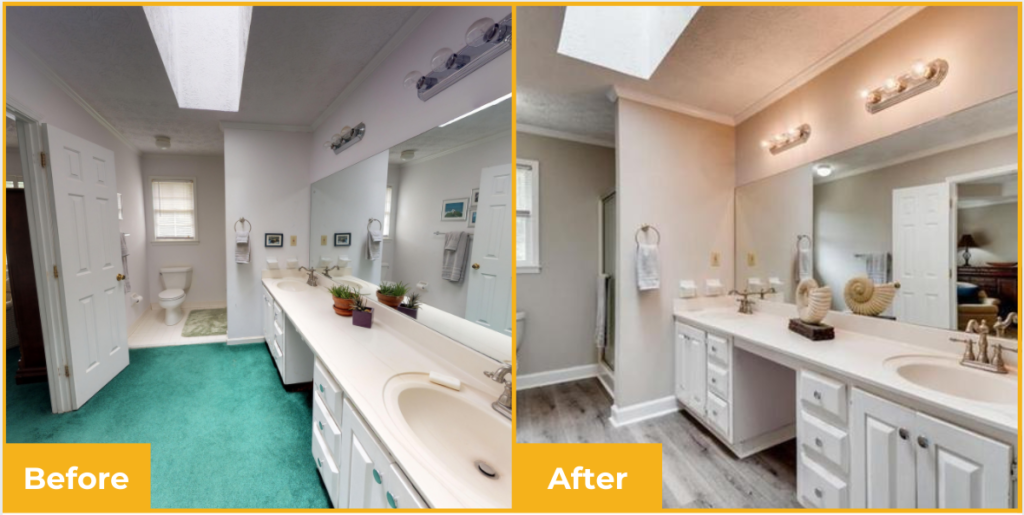
Getting a home ready to sell is about balance.
Even if you have a million dollar property, in Seattle that doesn’t necessarily mean luxury. You don’t need a big, expensive makeover. You just want the house to stand out in a good way without spending money you will not get back. My goal for you is to get a 3x ROI on any money that you put into improving the home. Otherwise, it’s probably not going to be worth the risk of time and money.
The goal is simply to make the home the obvious choice for the price range and neighborhood.
Most buyers are not looking for fancy upgrades.
They want a home that feels clean, cared for, and ready to move into. When a house looks neat and well maintained, buyers feel more confident about making an offer. It gives them peace of mind.
When it’s TOO old, it gives a “major rehab project” vibe which will affect your cost. It can also give a “gross-out vibe if it has 50 year old kitchen cabinets or rec room carpets…” I’m just saying…
The best updates are often small ones.
- Fresh paint can make rooms feel bright and new.
- Replacing old carpet or adding LVP flooring can make the whole home feel updated.
- A deep professional cleaning makes a huge difference.
- Fixing small things like loose handles, squeaky doors, or chipped trim also helps more than you might think.
These simple steps can make your home shine without overspending. Focus on clean, fresh, and move-in ready. That is what helps a home sell faster and for the best possible price. Often $5,000 – $10,000 in home renovations can make a huge difference in the marketability of your property.
Sometimes more extensive repairs are recommended, but the choice is yours. If we’re going to put money into a property, we want to see more than a 1-to-1 return on investment. I like to see a 1-to-3 return on investment to really make extensive updates worth the time and effort.
If it helps, I can coordinate vendors who get paid at closing, so you’re not fronting cash unnecessarily.
What About Interior Home Staging?
If the home is vacant — which the market often prefers — staging can be one of the highest-ROI investments you make.

Staging:
- activates the emotional side of buyers’ brains,
- helps them visualize living there,
- prevents hyper-focus on minor flaws.
Typical costs:
- ~$4,000 upfront, depending on how many rooms will be staged.
- ~$500/month furniture rental, while listed
According to the National Association of Realtors, staged homes often sell for 3–6% more, making this one of the few improvements that consistently pays for itself.
Staging can be a great investment. If it’s not something you can afford upfront, it’s not 100% necessary. Sometimes when i work with clients I budget some of my marketing money toward staging your home, so if this is something you’d like to discuss, we can talk about how to make it work for your situation.
Buyer Representation: How Realtor Fees Work Now
In almost all NWMLS transactions, the seller pays the buyer’s agent fee. Although this is not required, a study of 50 homes that offered a 0% commission to the buyer’s agent usually failed to sell, or sold for 3% less than they otherwise would have. In other words, failing to offer compensation to buyers agents did not increase the net income to sellers.
When we decide on how to price your home, we can look at what other agents are being paid nearby (commission comps) to get an idea for what is common in your area and at your price point.
****
When I work with buyers, I work under a 3% representation agreement.
My goal is always that buyers do not have to pay me out of pocket.
If a seller does not offer full compensation, we explore options such as:
- requesting broker compensation when we make an offer to purchase the home,
- if necessary, structuring the price to account for the commission,
- or adjusting strategy, if needed.
Only as a last resort would a buyer be asked to contribute — and that decision is always made in advance, with full transparency, and at the buyer’s discretion.
For more information on my costs and fees for buyers, click here.
****
Buyer consultations and agreements are now a standard part of the home buying process in Washington State, much like filling out intake forms at a doctor’s office. This establishes clarity, professionalism, and equal footing from the start.
The way buyer’s employ their agents now generally means that they are committed to compensating their agent at a certain level when they find the home they like, and most agents do their best to get sellers to cover this fee. Most sellers chalk it up as a cost of doing business.
Who Full-Service Representation Is (and Isn’t) For
Full-service representation is often the right fit for home sellers if:
- you want to maximize profit,
- your property has complexity (condo, HOA, probate, repairs),
- you’re relocating or time-constrained,
- a previous attempt to sell didn’t work,
- or you want strong advocacy and calm leadership.
It may not be the best fit if:
- you want a fast, as-is sale to investors,
- or your priority is speed over price.
In those cases, we can design a different strategy, including offering a cash purchase price from our investment wing as well as competitive MLS exposure, that still protects you better than a direct investor sale.
Excise Tax – Washington State Loves To Tax You!
When you sell a home in Washington, you will pay the Washington State Real Estate Excise Tax, often called REET. This is a seller-paid tax based on the total sales price, not your profit. It uses a graduated tier system, meaning different portions of the sales price are taxed at different rates.
State REET Tiers:
- 1.10% on the first $525,000
- 1.28% on the portion from $525,001 to $1,525,000
- 2.75% on the portion from $1,525,001 to $3,025,000
- 3.00% on any amount above $3,025,000
In addition to the state tax, most cities and counties add a local excise tax, commonly:
- 0.25% of the full sales price
(Some local jurisdictions may charge slightly more.)
Because REET is calculated on the entire sales price and not just your gain, it can be one of the largest costs in a Washington home sale. For higher-priced homes, this often adds up to tens of thousands of dollars, so it is important to calculate this carefully when estimating your net proceeds.
Capital Gains Tax – Uncle Sam Is Coming For You, Too!
Sellers should also expect standard closing costs. These usually include title insurance, escrow fees, recording fees, and other transaction-related charges. While buyers and sellers sometimes negotiate who pays for certain items, sellers commonly cover a portion of these expenses. In total, closing costs often range around 1 to 2 percent of the sales price, depending on the specifics of the transaction. These are the behind-the-scenes costs that make the transfer of ownership official and legally secure.
Closing Costs – These are the Mysterious, Ambigous Fees That Always Get Added On To Your Transaction
Finally, there is capital gains tax, which applies only to your profit, not the full sales price. If the home has been your primary residence for at least two of the past five years, you may exclude up to $250,000 of gain from taxes if you are single, or up to $500,000 if you are married filing jointly. Any profit above those limits may be taxed at the applicable capital gains rate. Not every seller owes this tax, but if your home has appreciated significantly, it is wise to review your situation with a tax professional before you list.
EXAMPLE: Let’s Spell It Out
How Much Does It Cost to Sell a Home in Seattle?
Then give a structured table.
Example:
| Cost Category | Typical Range in Seattle | Who Pays |
|---|---|---|
| Listing Agent Commission | 3% | Seller |
| Buyer Agent Compensation | 2.5%–3% | Seller (optional but common to have buyer pay it) |
| Washington REET (Excise Tax) | 1.1%–3% tiered | Seller |
| Title & Escrow | 0.5%–1% | Negotiable |
| Staging | $4,000+ | Seller |
| Prep & Repairs | Varies | Seller |
So what would this look like for a $1 Million Dollar Property?
Assumptions used in this example:
- 3% listing agent commission
- 2.5% buyer agent compensation
- WA State REET tiers applied
- Typical escrow/title costs
- No staging or repair credits included
- No mortgage payoff included
Estimated Seller Closing Costs Table
| Cost Category | Calculation | Estimated Cost |
|---|---|---|
| Listing Agent Commission (3%) | $1,000,000 × 3% | $30,000 |
| Buyer Agent Compensation (2.5%) | $1,000,000 × 2.5% | $25,000 |
| WA State REET (Graduated) | See breakdown below | ~$12,800 |
| Local Excise Tax (varies by city) | Approx. 0.25% | ~$2,500 |
| Title & Escrow Fees | Typical range | ~$4,000 – $6,000 |
| Recording & Misc Fees | Estimate | ~$500 |
| Estimated Total Costs | ~$74,000 – $76,000 |
WA State REET Calculation on $1,000,000
Washington uses a graduated system:
- 1.1% on the first $500,000 → $5,500
- 1.28% on $500,000–$1,000,000 → $6,400
Total State REET = $11,900
When you add typical local excise taxes, total transfer taxes are usually around $14,000–$15,000 combined depending on municipality.
Estimated Net Proceeds (Before Mortgage Payoff)
| Sale Price | $1,000,000 |
|---|---|
| Less Estimated Selling Costs | ~$75,000 |
| Estimated Net Before Loan Payoff | ~$925,000 |
If the seller has a mortgage, that payoff would be subtracted from the $925,000 figure.
Final Thought: You’re Hiring an Advocate, Not a Line Item
When you hire me, you’re not just paying for:
- paperwork,
- showings,
- or a listing on the MLS.
You’re paying for:
- industry experience and market knowledge which will inform your strategy,
- negotiation skills to keep the balance of power on your side,
- risk management to help deals stay together, and protect your cash and your transaction’s integrity, as well as your liability now and for years to come,
- and someone who is fully invested in your success.
The goal isn’t to “save a little on commission.”
The goal is to hire a bulldog and walk away with the most money possible, with the least stress, and the highest likelihood of a successful closing.
If you’d like to see what a sale or purchase might look like for you, including net proceeds or buyer costs, I’m always happy to walk through that with you.
For more information about working with Emily Cressey, Seattle Realtor, please fill out the form below.
How Can We Help You?
We would love to hear from you! Please fill out this form and we will get in touch with you shortly.