
Should You Buy in Seattle Now or Wait for Prices to Drop?

Quick Answer: Buying in Seattle now can make sense even as prices soften, if the home fits your life and your budget. Inventory sits near a multi-year high and sellers are negotiating, so buyers have real bargaining room. A lower rate can be refinanced later; overpaying on price cannot.
By Emily Cressey | August 9, 2026
You have probably heard both stories this summer. One friend swears prices are about to fall off a cliff, so you should wait. Another says rates are the only thing that matters, so you should buy the second you can. Both cannot be right, and neither one has run the math on your specific situation.
So let’s do that here. This is a buyer’s reality check for Greater Seattle in August 2026, written for two kinds of people: the couple relocating here from out of state who wants to time the move well, and the local family ready to size up from a starter home in Renton or Shoreline to something bigger in Sammamish or Bothell. The market has genuinely shifted in your favor. Whether that means “buy now” or “wait” depends on numbers you can actually calculate, and I will show you how.
The Seattle market has tilted toward buyers, and the data backs it up
For years, buying here felt like a blood sport. You waived inspections, wrote love letters, and still lost to an all-cash offer $80,000 over asking. That version of Seattle has cooled off.
Look at what changed by mid-2026. Across the Northwest MLS region, there were more than 23,000 active listings on the market at the end of June, up from just under 20,000 a year earlier, a jump of roughly 16 percent (per NWMLS). In King County, resale inventory has run up even faster. More homes sit for sale now than at almost any point in recent memory, and that single fact rewrites the rules of who holds the upper hand.
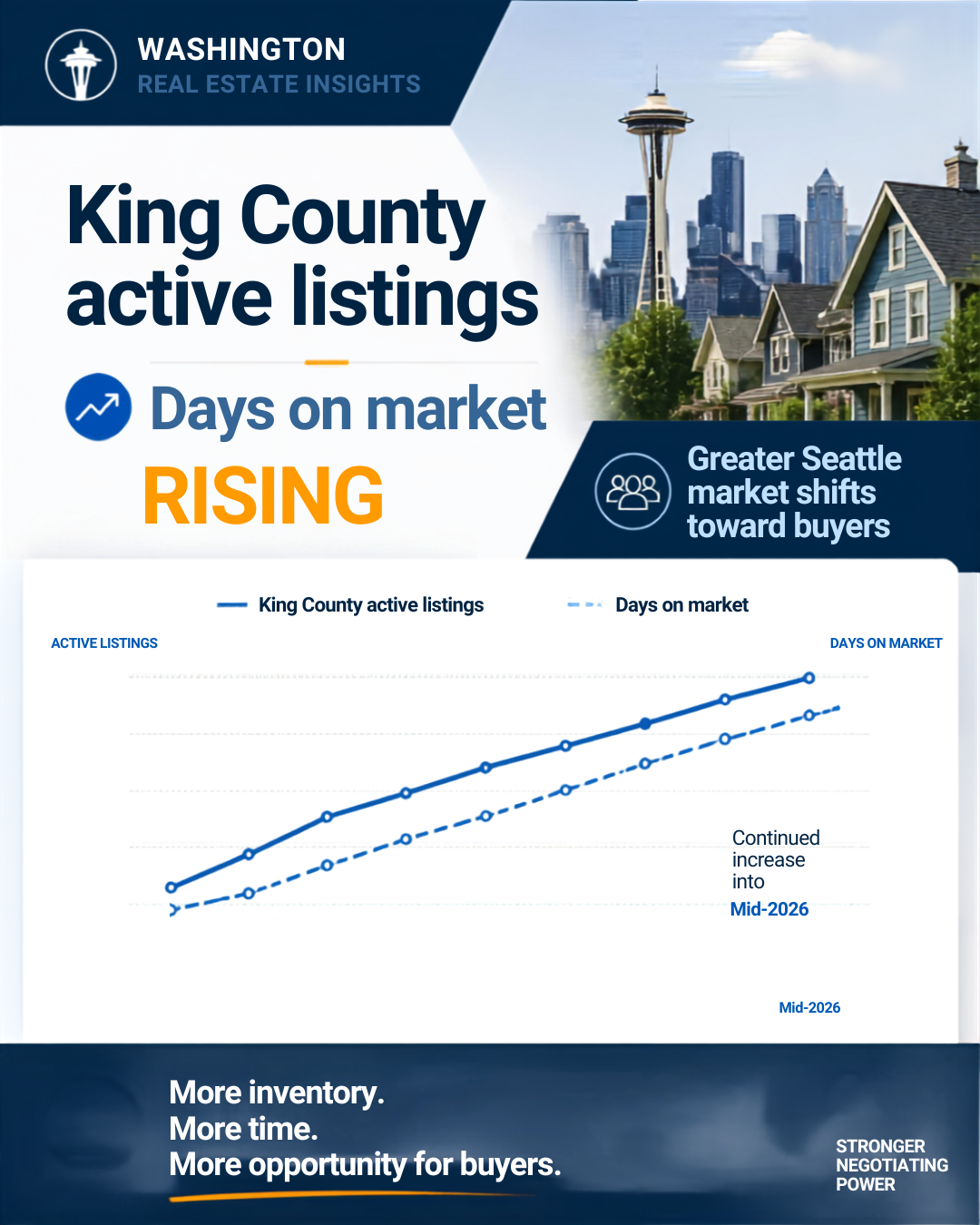
More supply changes buyer behavior in three concrete ways.
First, homes take longer to sell. In King County, single-family homes were averaging around 18 days on market this summer, close to a week longer than the same stretch a year ago. Condos in the Seattle core were sitting closer to 40 days. When a listing lingers, the seller starts watching the calendar, and that is your opening.
Second, prices have stopped climbing and started drifting down a touch. Average King County home prices were running a couple of percentage points below last year, with condos softer than single-family. That is not a crash. It is a market letting some air out after a long run, which is a very different thing.
Third, months of supply has moved into balanced territory, around 3 months in King County. Under 3 months usually favors sellers, and above 6 favors buyers. Sitting near the middle means you can actually shop, compare, and negotiate instead of sprinting to beat 12 other offers.
The shift is not uniform, and that matters for where you look. Condos in downtown Seattle, Belltown, and parts of the Eastside have softened more than single-family homes, so a condo buyer often has the most room to negotiate right now. South King County towns like Kent, Auburn, and Federal Way, along with parts of Snohomish and Pierce counties near Everett and Tacoma, tend to carry more inventory and more flexible sellers than the tight, high-demand pockets of Kirkland, Bellevue, or Ballard. If your search is flexible on location, you can point it toward wherever the bargaining room is strongest.
If your listing agent friends have been complaining that homes are not moving, they are not wrong. I wrote a whole piece on that from the seller’s side in why your house isn’t selling in Seattle in 2026. Every frustration a seller feels right now is a lever a prepared buyer can pull.
So the buyer’s edge is real. The question is what you do with it, and that comes down to the math.
The math: date the rate, marry the house
Here is the phrase you will hear from every honest agent this year: date the rate, marry the house. The idea is simple. You commit to the home for the long haul, but the interest rate is temporary. If rates fall later, you refinance into the lower one. You cannot, however, go back and renegotiate the price after you close. That number is locked in forever.
That matters because of how the two forces actually move your monthly payment. Most buyers assume a price drop and a rate drop are roughly the same size of win. They are not even close.
Let’s run a realistic Greater Seattle scenario. Picture a $750,000 home, which lands you a solid single-family house in places like Renton, Kent, Everett, or a townhome in closer-in Seattle. Put 20 percent down, so you borrow $600,000 on a 30-year fixed. The most recent Freddie Mac weekly average for a 30-year loan was 6.66 percent (per Freddie Mac PMMS). Watch what happens to the monthly principal and interest under different “what if” scenarios.
| Scenario | Purchase price | Loan amount | Rate | Monthly P&I | Change vs. buying now |
|---|---|---|---|---|---|
| Buy now | $750,000 | $600,000 | 6.66% | $3,856 | Baseline |
| Price falls 5%, rate holds | $712,500 | $570,000 | 6.66% | $3,663 | Save $193/mo |
| Price holds, rate falls 1 point | $750,000 | $600,000 | 5.66% | $3,467 | Save $389/mo |
| Both happen: price down 5%, rate down 1 pt | $712,500 | $570,000 | 5.66% | $3,294 | Save $562/mo |
| Price holds, rate rises 1 point | $750,000 | $600,000 | 7.66% | $4,261 | Pay $405 more/mo |
Sit with that table for a second, because it holds the whole decision.
A full 5 percent price cut, which is a meaningful drop in a market that is only softening gently, saves you about $193 a month. A one-point improvement in your rate saves you roughly twice that, close to $389 a month, on the exact same house. Rate moves the payment far more than price does, because the rate applies to every dollar you borrow across all 360 payments.
Now here is the part that ties it back to “date the rate.” The rate win is the one you can capture later. If you buy now at 6.66 percent and rates ease into the mid-5s next year, you refinance and pocket that $389, no re-shopping and no bidding war required. But the price you negotiate today, while inventory is high and sellers are motivated, is locked in. You get that discount once, and only if you are actually in the market to ask for it.
The bottom row is the honest warning shot, though. If you wait and rates go the wrong way, up a point instead of down, that same house costs you $405 more every month, and no 5 percent price cut fully rescues you. Timing works both directions.
There is also a way to bring your rate down today without waiting at all. In a softer market, motivated sellers will often pay for a rate buydown, where a chunk of the seller’s money is used to lower your interest rate for the first year or two, or even for the life of the loan. A temporary 2-1 buydown, for example, can knock your rate down two points in year one and one point in year two while rates hopefully ease. That is “date the rate” in its most literal form, and it is exactly the kind of concession that is on the table when a home has been sitting for a month. You do not always have to wait for the market to hand you a lower payment. Sometimes you negotiate it.
The real risk of waiting, and when waiting is actually the right call

I am not going to tell you to buy today no matter what. That would make me a salesperson, not an advisor. Waiting is genuinely the right move for some people. Let’s be fair about both sides.
Waiting makes sense if your job is shaky, your down payment is not quite there, or you would be stretching so thin that a broken furnace would wreck you. It also makes sense if you truly have not found a home you love. Buying the wrong house to beat the market is how people end up selling again in three years and eating the transaction costs. No math fixes a bad fit.
But waiting carries a risk that most people underestimate, and it is the mirror image of the edge you have right now. The reason you can negotiate today is that a lot of buyers are sitting on the sidelines. The moment rates drop meaningfully, those buyers come flooding back all at once. That is when competition returns, multiple offers come back into style, and the polite negotiating you are enjoying now disappears.
Think it through. If you wait for a 5.66 percent rate, you will not be the only one who noticed. Everyone who has been waiting jumps in the same month. Suddenly you are competing again, sellers stop reducing prices, and the very discount you were hoping for evaporates. You may win the lower rate and lose the negotiating room, which the table above shows is where the smaller savings lived anyway.
There is a subtler cost too. Every month you rent while waiting is a month you build zero equity and pay someone else’s mortgage. On a $750,000 home, even a slow-and-steady market builds meaningful equity over a few years through simple loan paydown and modest appreciation. Waiting for a perfect entry point can end up costing more than the discount you are chasing.
For the relocating couple, there is one more wrinkle. If you are moving to the Seattle area for a job, your timeline is often set by that job, not by the housing cycle. Renting for a year “to see what happens” means two moves, two sets of costs, and a year of not knowing your neighborhood, your commute to Bellevue or Redmond, or how the area actually feels on a rainy Tuesday morning. Sometimes the market-timing question is smaller than the life-timing question, and that is okay to admit.
For the local move-up buyer, remember you are usually on both sides of the deal. You are selling your current place into this same softer market while buying the next one. A gentler market can trim your sale price, but it also trims what you pay for the bigger home, and the bigger home’s dollar discount is larger because it is a bigger number. If you are selling first, get clear on your net proceeds, including Washington’s excise tax, which I break down in the WA real estate excise tax guide for sellers. Knowing your walk-away number turns a stressful double-move into a plan.
Nationally, the picture rhymes with ours. The median existing-home price was around $440,600 in June, with about 4.6 months of supply (per NAR). Seattle prices sit well above that median, but the same theme holds across the country: more choice for buyers, and sellers adjusting to it. This is not a Seattle-only blip.
So who should lean toward buying now? If you have stable income, your down payment ready, and you have found a home you would be happy in for at least five to seven years, the current mix of real inventory and softer prices is a genuinely good window. You negotiate today, and you keep the option to refinance tomorrow. That is the combination the math actually rewards.
Frequently asked questions
Is now a good time to buy a house in Seattle in 2026?
For financially stable buyers who plan to stay put for several years, yes, this is one of the friendlier windows in a while. Inventory is near its highest in more than a decade, days on market are up, and sellers are negotiating. The catch is that “good time” is personal. If your income or down payment is not solid, the market being buyer-friendly does not change that. Run your own numbers first.
Will Seattle home prices keep dropping in 2026?
Prices have softened modestly, running a couple of percentage points below last year in King County, but this is a gentle cooldown, not a crash. Most forecasts point to a flat-to-slightly-soft market rather than a big decline, largely because the region still does not have enough housing for the number of people who want to live here. Betting on a large price drop is a gamble, not a plan.
Should I wait for mortgage rates to fall before buying?
Maybe, but understand the trade-off. A lower rate can be captured later through a refinance, while a lower price can only be captured while you are actively in the market. If you wait for rates to fall, expect sidelined buyers to rush back and competition to return, which can erase the negotiating room you have today. That is the heart of “date the rate, marry the house.”
How much negotiating room do buyers have in Greater Seattle right now?
More than they have had in years. With months of supply near balanced levels and homes sitting longer, buyers are winning price reductions, closing-cost help, rate buydowns, and repair credits, especially on listings that have been on the market for a few weeks. The exact room depends on the specific home, the seller’s motivation, and how the property is priced.
What does “date the rate, marry the house” mean?
It means commit to the right home for the long term, but treat your interest rate as temporary. If rates drop later, you refinance into the lower payment. You cannot renegotiate the purchase price after closing, so the price you lock in today, while sellers are flexible, is the one you keep. The saying reminds buyers not to let a temporary rate stop a long-term decision.
The honest bottom line
Waiting for the “perfect” moment usually means guessing, and the people who guess tend to catch the worst of both worlds: they wait through the negotiating window, then buy once competition roars back. The math is clearer than the guessing game. Right now you have room to negotiate on price, and you keep the option to fix your rate later. That is a strong hand.
The right answer still depends on your income, your timeline, and the specific home. So let’s run your actual numbers instead of the internet’s averages. Book a buyer-strategy call and I will walk you through what a home in your price range really costs per month, how much negotiating room to expect in your target neighborhoods, and whether buying or waiting fits your plan. You can reach me at HomePro Associates any time.
Relocating to the area? Text HOME to 206-245-8813 and I will send you the Greater Seattle relocation guide, plus you can start browsing real listings at HomeProHouses.com. No pressure, no spam, just a clear picture so you can decide with confidence.
About the Author: Emily Cressey
Emily Cressey is a licensed real estate broker with HomePro Associates at Keller Williams Greater Seattle. She helps buyers, sellers, and relocating families across King, Snohomish, and Pierce counties make confident decisions with straight talk and real numbers. Her tagline says it best: we make real estate EASY for you. Call or text Emily at 206-245-8813 or visit HomeProAssociates.com to start a conversation.