

How Much Will the Excise Tax Cost You as a Washington Home Seller?
How much is real estate excise tax in Washington in 2026?
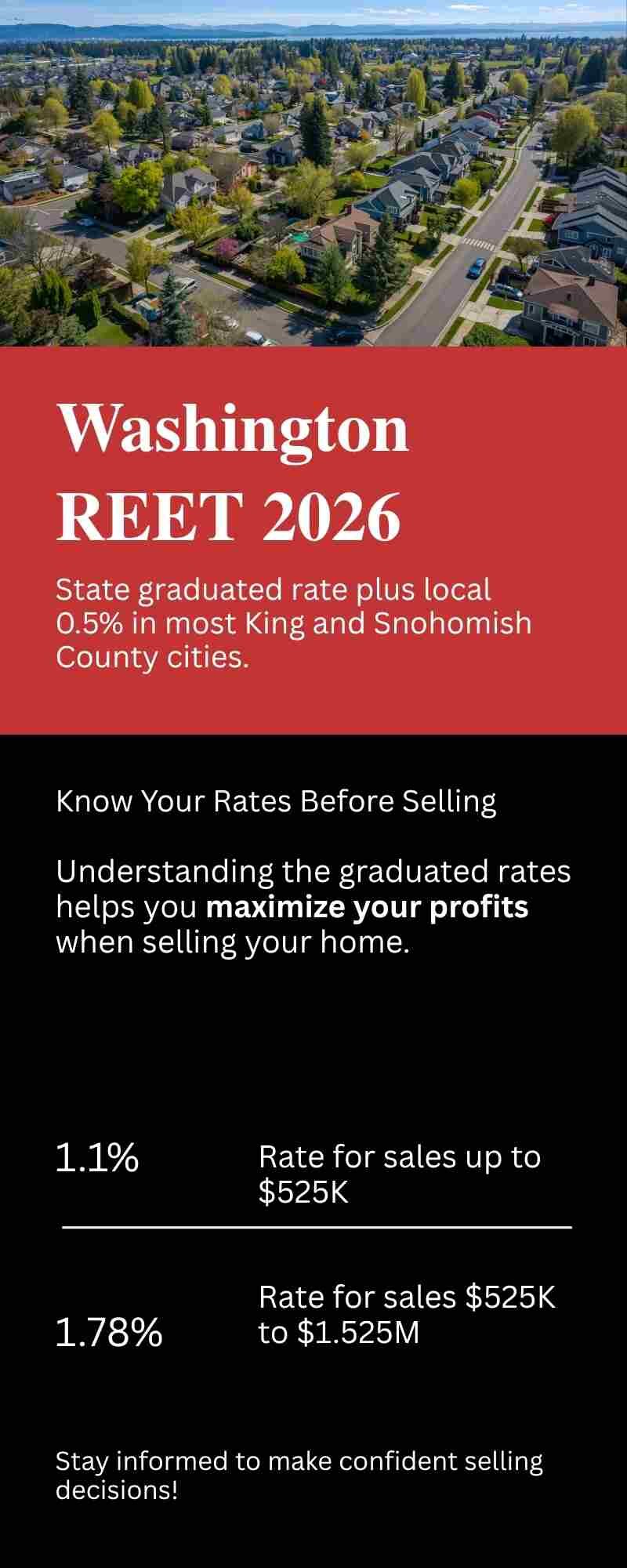
In Washington, sellers pay a graduated state Real Estate Excise Tax (REET) of 1.1% on the first $525,000 of sale price, 1.78% on the portion from $525,001 to $1.525 million, 2.75% on the portion from $1.525M to $3.025M, and 3.0% on anything above. Most King and Snohomish County cities add a local 0.50% on top. On a $1 million Seattle home, REET alone runs about $16,000. On a $1.5M home, it runs about $26,000. Sellers pay it at closing through escrow.

Almost every Greater Seattle seller I work with has the same reaction when they see their preliminary closing statement for the first time. They look at the REET line. They blink. They say something like, “Wait, that’s how much?”
It’s the most predictable surprise in a Washington home sale. And it’s the reason a real net sheet matters before you list, not after.
Let’s walk through what REET actually is, what it costs at common Greater Seattle price points, and the (limited) ways to reduce or avoid it legally.
Quick takeaway: Washington’s REET is paid by the seller, calculated on the gross sale price (not your profit), and split between the state and your local city or county. Plan for 1.6% to 3.5% of your sale price depending on price tier and city.
Washington’s Graduated REET, Explained Plainly
Until 2020, Washington had a flat 1.28% REET. Today the state portion is graduated, meaning different slices of your sale price are taxed at different rates. Local cities and counties add their own piece on top.
Here’s how the state portion stacks up at the rates effective for 2026:
| Sale Price Slice | State REET Rate | What That Means in Dollars |
|---|---|---|
| $0 to $525,000 | 1.1% | Up to $5,775 on this slice |
| $525,001 to $1,525,000 | 1.78% | Up to $17,800 on this slice |
| $1,525,001 to $3,025,000 | 2.75% | Up to $41,250 on this slice |
| $3,025,001 and above | 3.0% | 3% on every dollar above $3.025M |
The local layer matters too. Most Greater Seattle cities (Shoreline, Lynnwood, Bothell, Kenmore, Lake Forest Park, Mountlake Terrace, Brier, and Seattle proper) add 0.50% to the state portion. You’ll want to confirm your specific city’s rate. The full table for every Washington jurisdiction lives on the Washington Department of Revenue’s REET page.
So a typical Seattle-area total comes out to roughly:
- Sub-$525K home: 1.1% state + 0.5% local = 1.6% total
- $700K-$1M home: blended rate around 1.85% to 2.0% total
- $1.5M home: blended rate around 2.05% total
- $2.5M home: blended rate around 2.4% total
That’s just the REET line. It sits on top of agent commissions, escrow fees, title insurance, prorated property taxes, and your mortgage payoff. Here’s the full Seattle closing cost picture if you want the wider view.
Why Sellers Get Blindsided
Three reasons REET surprises so many Washington sellers, even savvy ones who’ve sold homes in other states.
One. Most other states either don’t have a transfer tax or it’s a sliver of the rate. California’s average local transfer tax runs around 0.11%. Texas has none. Florida is 0.7%. Coming from those states, a 2% REET line item lands hard.
Two. The graduated structure means your effective rate creeps up as your home value crosses thresholds, but most online cost calculators flatten the math. By the time the real number lands on your closing statement, the number is bigger than the calculator promised.
Three. Washington has no state income tax and no capital gains tax on real estate, so people assume “low-tax state” applies all the way through. It doesn’t. Washington funds infrastructure and affordable housing through transfer taxes instead. The REET line on your closing statement is essentially the bill for that choice.
Can You Reduce or Avoid REET? (Mostly No, but Read This)
For a normal arms-length sale, there’s no legal way to reduce REET on the actual transaction. The rate is statutory. Escrow collects it on behalf of the state and county. There’s no negotiation.
That said, Washington DOR publishes a list of REET exemptions that apply to specific transfer scenarios. The most common ones I see in practice:
- Inheritance / devise by will. Property passing to an heir is exempt. Once that heir later sells the property to a third party, REET applies normally.
- Gift of real property. A true gift (no consideration given in return, no debt assumed) is exempt. Equity can be gifted. Mortgage debt can’t.
- Transfer to a wholly-owned LLC with no change in beneficial ownership. If you and your co-owners transfer the property to an LLC and you each own the same proportional share of the LLC as you owned of the property, REET is exempt. There’s a 3-year clawback if the LLC then transfers ownership outside that family group.
- Divorce decree. Court-ordered transfers between spouses pursuant to divorce are exempt.
None of these help with a regular sale. They matter for estate planning, intra-family transfers, and business restructuring. If any of those situations describe yours, the right call is a chat with a real estate attorney or CPA before you list, because the timing and paperwork matter.
The Net Sheet Conversation (Have It BEFORE You List)
Here’s the practical move that changes the surprise factor from “shocking” to “planned for”:
Before you list, have your agent build a real net sheet. Not a Zillow estimate. Not a back-of-envelope number. A line-item breakdown that includes:
- Estimated sale price based on current comps in your specific neighborhood
- Agent commission (yours plus any buyer’s agent compensation you’re offering)
- Washington REET calculated on the actual estimated sale price for your specific city
- Escrow fees (typically $500 to $900)
- Title insurance (typically $800 to $1,500)
- Prorated property taxes through closing
- Recording fees ($150 to $250)
- Mortgage payoff (your lender provides this)
- HOA dues, if applicable
- Any seller-paid concessions
That number, once you see it, becomes your planning number. You can use it to write a confident offer on your next house, decide whether the timing makes sense, or reset your asking price if the math doesn’t work. It’s a one-hour conversation that prevents weeks of “Wait, that’s how much?”

What This Means for King and Snohomish County Sellers Specifically
The Greater Seattle price ranges I work with most often (Shoreline, Lynnwood, Bothell, Kenmore, Lake Forest Park, Mountlake Terrace, Brier) typically land in the $700K to $1.5M range. That puts most sellers squarely in the second REET tier where the 1.78% state rate kicks in.
If you’re selling a $900,000 home in Bothell, your combined REET runs roughly:
- State REET: $5,775 (on the first $525K) + $6,675 (on $375K from $525K to $900K at 1.78%) = $12,450
- Local REET (0.50%): $4,500
- Total REET: about $16,950
That’s roughly 1.88% of your gross sale price, just for excise tax. Add commission, escrow, title, and prorations and you’re typically looking at 7% to 9% of the sale price gone before your mortgage payoff. My breakdown of how to lower closing costs in Shoreline and surrounding areas is a good companion piece if you’re trying to trim where you can.
For higher-end sellers in the $2M+ range, the 2.75% tier on the upper slice changes the math meaningfully. My deeper guide to the Seattle seller closing process walks through what happens between mutual acceptance and closing day, including when REET gets calculated.
And if you’re a longer-time owner thinking about cash flow before, during, and after the sale, my long-term ownership costs piece breaks down what tends to show up after closing too (insurance, taxes, maintenance, and the carrying-cost basics most people forget). Pair that with my Shoreline seller walkthrough if you’re selling a home in any of the North King County or south Snohomish County cities and want a cleaner, less stressful process.
Frequently Asked Questions
Who actually pays REET, the buyer or the seller?
The seller. REET is the seller’s obligation under Washington law. Escrow collects it from the seller’s proceeds at closing and remits it to the state and county. The only way it ends up on the buyer’s side is if you specifically negotiated a credit or concession that covered it, which is rare in 2026’s market.
Is REET calculated on my profit or on the full sale price?
The full sale price. Not your equity. Not your profit. Not the amount above your mortgage. The gross selling price. Which is why even sellers who break even or take a small loss still owe the full REET amount.
Does REET apply to a vacant lot or land sale?
Yes. The graduated rates apply to all real property sales in Washington with a few specific exceptions (timberland and agricultural land are taxed at a flat 1.28% instead of the graduated structure).
I’m selling to my adult child at a discount. Do we still pay REET?
If money changes hands at any price, REET applies on the actual sale price. If it’s a true gift (no consideration), the gift exemption applies. If you sell at a deeply discounted price (say, $1), the WA Department of Revenue may treat it as part-sale, part-gift and apply REET to the sale portion. This is one of those situations where a 30-minute call with a real estate attorney or CPA before the transfer saves five-figure headaches.
How does REET interact with a 1031 exchange?
1031 exchanges defer federal capital gains taxes, but REET is a state and local transfer tax, not an income tax. REET still applies on the Washington side of a 1031 exchange. There’s no exemption.
Putting It Together
REET is one of the largest predictable line items in a Washington home sale. It’s also the easiest to plan for, once you know it’s coming.
If you’re thinking about selling in Shoreline, Lynnwood, Bothell, Kenmore, Lake Forest Park, Mountlake Terrace, Brier, or anywhere in the Greater Seattle area, grab my free “The Real Cost of Selling Your Home” PDF guide for a complete cost breakdown line by line. It’s free and you can download it directly from HomeProAssociates.com.
If you’d rather just talk through your specific numbers, text HOME to 206-245-8813 and I’ll send you a personalized net sheet. Or book a free 20-minute call at bit.ly/call-emily. (We can run the actual REET on your specific city and price point in about 10 minutes.)
Selling a home in Washington isn’t simple. But it shouldn’t be a series of nasty surprises either. The right plan, built before you list, makes the whole thing… EASIER.
Warmly,
Emily
These Articles May Also Help You
- What Is Step-Up in Basis for Inherited Property?
- How Long Does It Take to Sell a House in Seattle?
- Best Seattle Neighborhoods for Home Appreciation Potential
- Selling a Parent’s House Full of Stuff in Seattle
- Condos vs. Houses by Seattle Neighborhood: Where Each Makes Sense
