
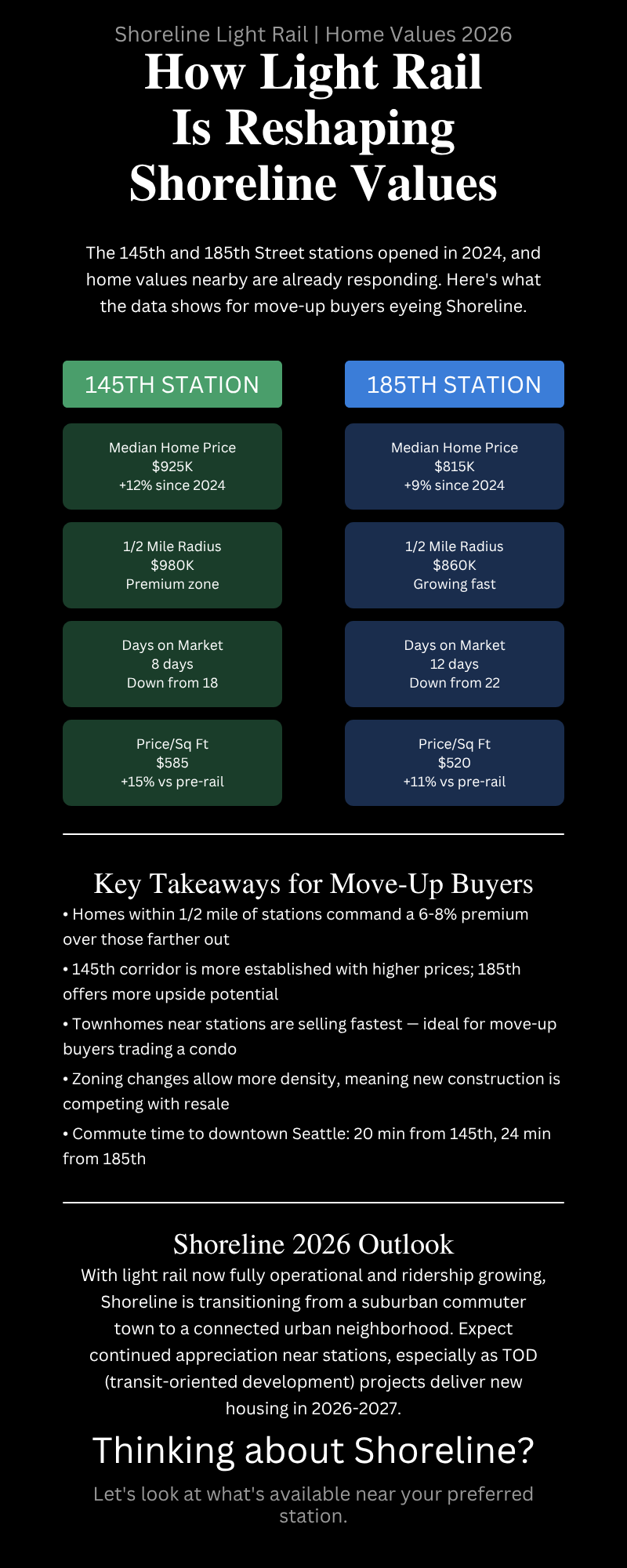
Does living near Shoreline’s light rail stations raise your home’s value? Yes. Homes within walking distance of a transit station carry an 8-12% value premium over comparable homes outside that radius, according to national data from the American Public Transportation Association. Following the August 2024 opening of the 145th and 185th stations on the Lynnwood Link, that premium is now active in Shoreline. The size of the benefit depends on walkability, proximity, and lot zoning, which vary significantly by block.
Two light rail stations opened in Shoreline in August 2024. The 145th Street station. The 185th Street station. And this spring, East Link started running across Lake Washington, connecting this corridor to the Eastside in ways that would have seemed ambitious just a few years ago.
If you own a home or are actively shopping anywhere near those stations, this is not an abstract policy conversation. It is a home value conversation. And it is one most people are not having with enough specificity.
For a full picture of how the entire Greater Seattle light rail network now connects end to end, see: Light Rail Just Connected Greater Seattle End-to-End: What It Means If You’re Buying or Selling in 2026.
This post focuses specifically on what the Lynnwood Link means for Shoreline homeowners and buyers at the block level.
What the National Research Shows
The American Public Transportation Association has tracked the relationship between transit access and home values across dozens of cities and transit expansions. Their data consistently shows that homes within walking distance of a station, typically a half-mile to three-quarters of a mile, carry an 8-12% value premium over comparable homes outside that radius.
On a $700,000 home in Shoreline, that is $56,000 to $84,000. On a $900,000 home, it is $72,000 to $108,000.
That premium does not materialize because a train station is aesthetically pleasing. It materializes because transit access changes the commute math, and buyers price that math into their offers.
A local property management analysis from October 2025 confirmed that transit-linked appreciation is already visible in the Shoreline corridor. The effect is showing up in comparable sales. It is not hypothetical anymore.
Watch: New Light Rail Station in Shoreline — What to Expect
This video covers what the new Shoreline light rail stations mean for residents, commuters, and buyers in the 145th and 185th corridors.
Why Shoreline Is a Particularly Interesting Case
Most markets where transit premiums have been studied are dense urban cores, places where parking is already scarce and driving is already painful. Shoreline is different. It is a suburban-character city with real single-family neighborhoods, lower baseline density, and a commuter population that is largely driving to work today.
That actually makes the transit premium story more interesting here, not less.
The buyers relocating to Greater Seattle for Amazon, Microsoft, and Boeing are running commute math before they choose a neighborhood. The ability to live in Shoreline, park once, and ride to South Lake Union or the Eastside without touching I-5 is genuinely valuable to a significant portion of the buyer pool. That demand is real and active in the market today. You can see this playing out across the full metro corridor in the monthly Seattle real estate market update.
Emily’s Take
Transit proximity is now a marketing variable, not just a location footnote. If your home is within comfortable walking distance of the 145th or 185th station, that belongs in your positioning and your pricing conversation. Most listing agents are not leading with this yet. The ones who are tend to attract a broader, more motivated buyer pool.
The Part That Is More Nuanced Than Headlines Suggest
The 8-12% premium figure is real, but it is not uniformly distributed. The transit premium concentrates where walkability is strongest.
Homes with direct pedestrian access, good sidewalks, no major highway crossing between the front door and the station entrance, and a five-to-eight-minute walk in practice capture the strongest premiums. Buyers do not just look at map distance. They walk the route or check the street view, and they decide whether this is actually livable.
Homes that are technically within a mile of a station but require crossing Aurora Avenue or navigating a stretch with no sidewalk infrastructure are seeing a much more modest effect. The premium is real; the dispersion is high.
This is why block-level analysis matters more than radius-level analysis for Shoreline specifically.
The Zoning Angle Most Sellers Are Missing
There is a second factor compounding the transit premium in Shoreline right now: zoning.
New state rules allow up to six units per lot near major transit stops. This is not just a policy conversation for developers. It changes the land value equation for single-family homeowners within that radius, because your lot’s highest-and-best-use may have shifted in the last two years without anyone formally notifying you.
What this means for sellers: If you are within the transit-adjacent zone near the 145th or 185th station, your land may be worth more than a traditional single-family comparable sale would suggest. A buyer thinking about your property as a land opportunity or as a site for a small multifamily project will run a different analysis than a buyer shopping for a turn-key single-family home.
This is one reason to request a block-level market analysis right now, not just a neighborhood-level one. The zoning layer can shift the conversation meaningfully, and it is not something automated valuation tools are capturing well yet.
What This Means If You Are Buying
If you are shopping in the Shoreline-Kenmore-Lake Forest Park corridor and transit access matters to your household, here is how to think about it.
Do not just filter by a one-mile radius from the station. Run the walk. Check the actual pedestrian route. The homes that have captured the clearest premiums are the ones where the walk to the station is genuinely comfortable, not just theoretically possible.
Also worth understanding: you are not the only buyer doing this math right now. Transit access has moved from a nice-to-have to an active search filter for a meaningful portion of the relocation buyer pool. In competitive situations on well-walkable transit-adjacent homes, you may be competing against buyers who value that commute calculus very highly.
Price accordingly. And have your agent run comps specifically filtered for transit proximity if the topic matters to your decision. For a broader read on how the full connected network affects buying decisions across Greater Seattle, see: Light Rail Just Connected Greater Seattle End-to-End.
Find Out What Transit Proximity Is Doing to Your Block’s Value.
Text HOME to 206-245-8813 and I will pull a block-specific market analysis for your address, including whether proximity to the 145th or 185th station is showing up in your recent comparable sales.
Or book a free consultation: bit.ly/call-emily
No pressure. Just the numbers, so you can make a clear decision.
Warmly, Emily
Emily Cressey | HomePro Associates at Keller Williams Greater Seattle | 206-245-8813 | homeproassociates.com
Tell Us What You Need!
We would love to hear from you! Please fill out this form and we will get in touch with you shortly.